Washington D.C. & Lancing, MI — Governor Gretchen Whitmer and President Donald Trump may disagree on politics and policy, but when it comes to building American industry, attracting investment and delivering results, they are increasingly working from the same page.
By DNN News
Governor Gretchen Whitmer and President Donald Trump may never see eye to eye on every issue.
They come from different political parties, represent different governing philosophies and continue to disagree over tariffs, environmental rules, federal spending, health care and numerous social policies. Their relationship during Trump’s first term was frequently confrontational, and neither leader has abandoned the principles that separate them.
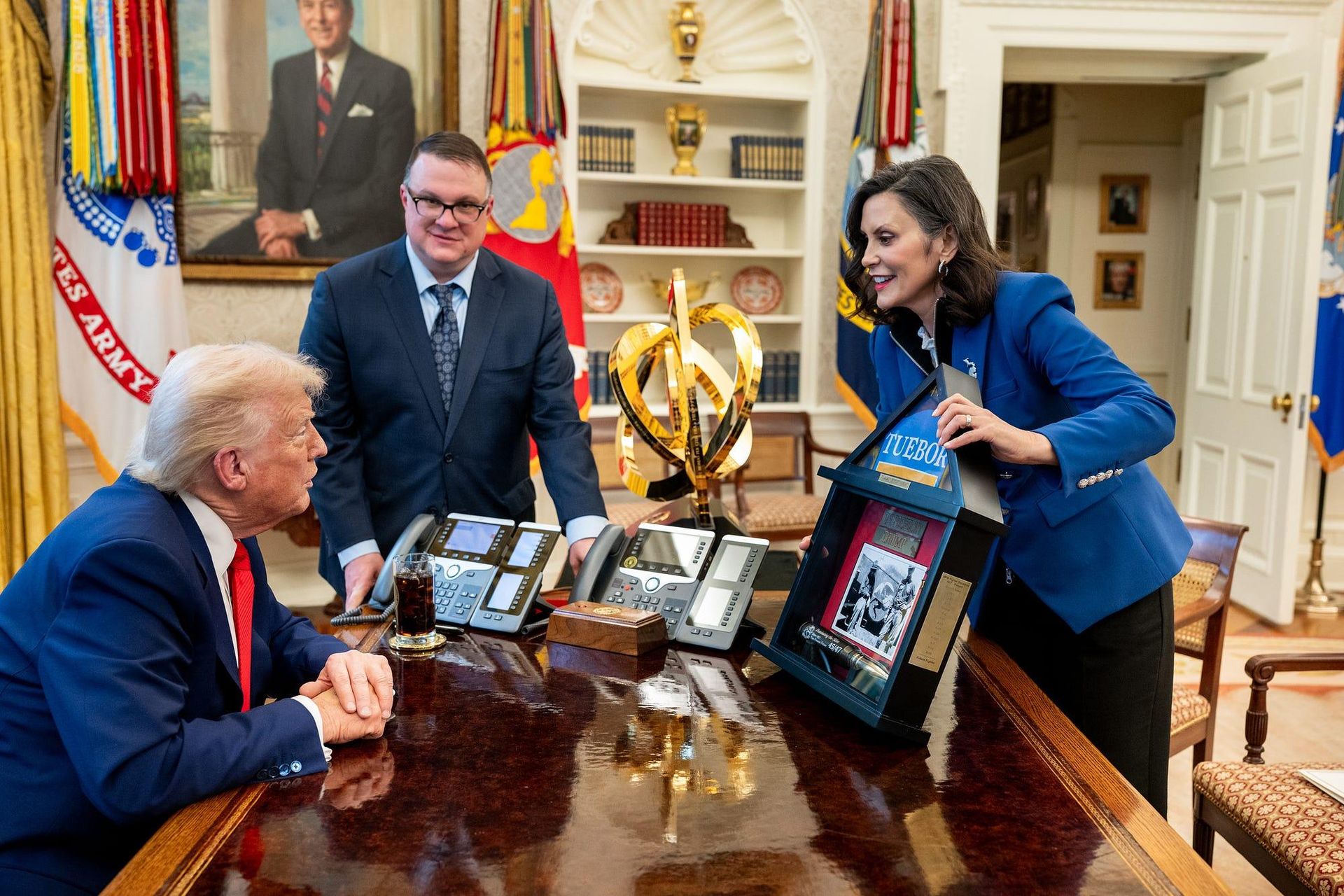
However, governing cannot be reduced to permanent political conflict.
When the issue is rebuilding American manufacturing, protecting Michigan jobs, attracting high-technology investment and getting major projects completed, Whitmer and Trump are increasingly moving in the same direction.
Their methods are not always identical. Their public language remains different. Yet both leaders recognize the same basic reality: America must build again.
The country needs semiconductor factories, artificial-intelligence infrastructure, reliable energy, advanced manufacturing, skilled workers, modern transportation systems and secure domestic supply chains. Michigan, with its industrial workforce and manufacturing history, has too much at stake to watch that transformation occur somewhere else.
Whitmer appears to understand that.
Rather than rejecting every Trump administration initiative because it comes from a Republican White House, she has adopted a more practical approach. She has met with Trump, supported domestic manufacturing, promoted semiconductor production, approved incentives for data centers and repeatedly called for bipartisan cooperation.
This does not mean Whitmer has become a Trump supporter. It means she recognizes that getting things done sometimes requires working with people with whom she strongly disagrees.
When it comes to delivering tangible results, both leaders appear increasingly willing to put Michigan and American industry ahead of partisan theater.
Different Parties, Similar Industrial Priorities
Trump’s economic strategy places domestic production, energy development, technological leadership and national independence near the center of federal policy.
His administration has moved to accelerate artificial-intelligence infrastructure, streamline permitting for data centers, expand nuclear power, increase domestic mineral production and encourage companies to manufacture more products inside the United States.
Whitmer has arrived at many of the same priorities from a different political direction.
Her administration has emphasized advanced manufacturing, electric and autonomous vehicles, semiconductor research, artificial intelligence, infrastructure and workforce preparation. She has called for bringing supply chains home, competing more directly with China and making Michigan a leading location for the industries of the future.
In her April 2025 “Build, America, Build” address, Whitmer called for cooperation between state and federal leaders to strengthen American manufacturing, rebuild domestic supply chains and protect national security. She argued that the country should manufacture more essential goods at home rather than remain dangerously dependent on foreign nations.
Those principles closely resemble the industrial case being advanced by the Trump administration.
The two leaders may dispute exactly how America should reach the destination, but they increasingly agree on where the country must go.
America must produce more.
It must build more.
It must generate more energy.
It must train more skilled workers.
It must reduce its dependence on foreign governments for strategically important products.
That shared direction creates an opportunity for meaningful cooperation.
Whitmer Chooses a Seat at the Table
Whitmer’s changing approach became especially visible through her meetings with Trump at the White House.
During Trump’s second term, she repeatedly traveled to Washington to discuss Michigan priorities, including the automotive industry, trade, disaster assistance, the Great Lakes and the future of Selfridge Air National Guard Base.
Whitmer has explained her approach plainly: she will work with anyone when doing so can produce results for Michigan.
That willingness has drawn criticism from some members of her own party, particularly those who believe Democratic governors should take a more confrontational approach toward Trump. However, Whitmer’s strategy has also produced tangible benefits.
Her engagement with the administration helped keep attention on Selfridge, an important military and economic asset in southeastern Michigan. Trump later announced a new fighter mission for the base, helping secure its future and the employment connected to it. Whitmer’s continued contact with the administration also coincided with federal storm-recovery assistance for Michigan.
Those results demonstrate the difference between political performance and practical governance.
Whitmer could have refused to meet with Trump and received praise from partisan critics. Instead, she entered the room and argued for Michigan.
The two may not agree on everything discussed at the table. But neither leader benefits when Michigan loses military missions, manufacturing investment or federal support simply because elected officials refuse to speak with one another.
Whitmer has recognized that a governor’s responsibility is not to win every national political argument. It is to advocate for the people and economy of her state.
The Semiconductor Industry Brings Them Together
Few industries demonstrate the emerging alignment more clearly than semiconductor manufacturing.
Semiconductors are essential to automobiles, communications equipment, medical technology, military systems, industrial machinery and artificial intelligence. The chip shortages experienced during and after the pandemic exposed the risks created when too much production is concentrated overseas.
Trump has made domestic semiconductor manufacturing a national economic and security priority. His administration has supported stronger domestic production requirements, trade measures and industrial policies intended to reduce American dependence on foreign suppliers.
Whitmer has also made semiconductor development a major Michigan priority.
In May 2025, she delivered a speech in Flint calling for Michigan to land a large semiconductor fabrication facility. She argued that the state needed stronger economic-development tools to compete for high-skill manufacturing projects and protect Michigan’s automotive supply chain.
Later that month, Whitmer set a goal of beginning construction on a semiconductor manufacturing facility before the end of her term.
Michigan has already invested in semiconductor research and workforce development. The state committed $10 million to the Michigan Semiconductor Talent and Technology for Automotive Research initiative, commonly known as MSTAR. The program is designed to strengthen automotive semiconductor research and develop workers with specialized technical skills.
This is precisely the kind of state-level preparation needed to complement a national manufacturing strategy.
The federal government can encourage semiconductor companies to expand inside the United States, but individual states must compete for the factories, suppliers, laboratories and jobs.
Whitmer understands that Michigan cannot remain the center of American automotive engineering while depending almost entirely on other countries for the computer chips controlling modern vehicles.
Trump understands that America cannot remain a global superpower while depending on overseas supply chains for components essential to national defense and the broader economy.
On this issue, their interests clearly overlap.
Artificial Intelligence Requires More Than Software
The rapid development of artificial intelligence is creating another area of practical agreement.
Trump’s administration has treated AI leadership as a national strategic priority. It has moved to reduce regulatory barriers, accelerate data-center development and connect AI policy with the energy and industrial infrastructure needed to support it.
In July 2025, the administration issued an order directing federal agencies to accelerate permitting for qualifying data centers and related infrastructure, including electrical transmission, power generation and semiconductor facilities.
Whitmer has also positioned Michigan to compete for data-center and artificial-intelligence investment.
In January 2025, she signed legislation expanding tax exemptions for qualifying investments in data-center equipment. The stated purpose was to encourage data-center construction, job creation and additional local tax revenue.
The enterprise data-center exemptions took effect in April 2025.
This was not an insignificant policy decision.
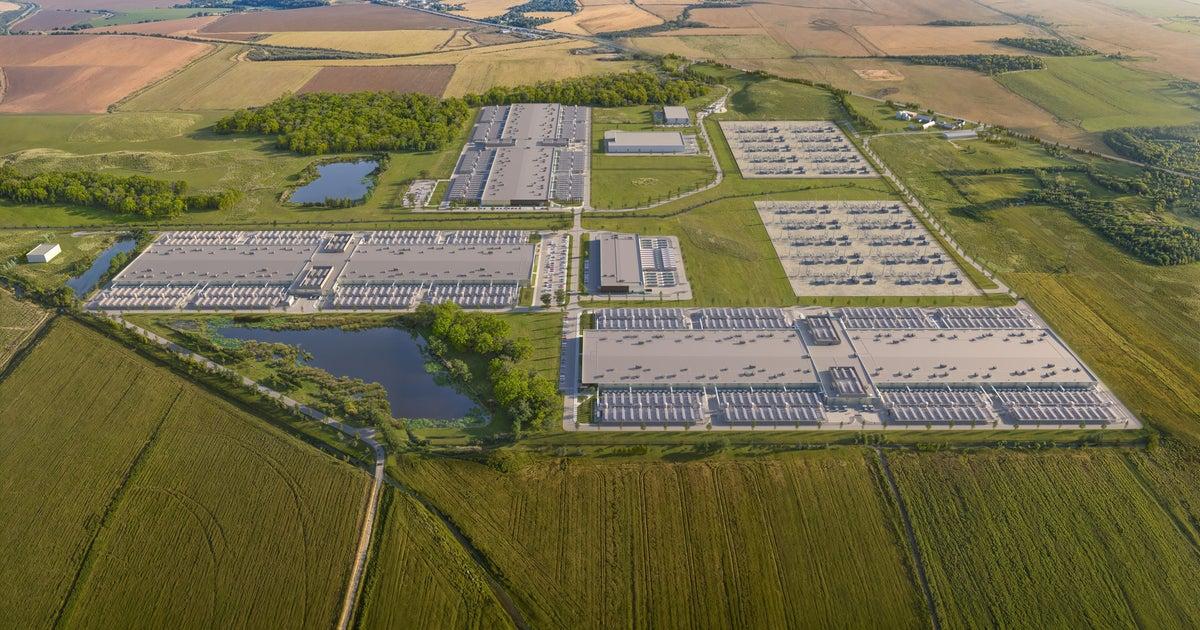
Large data centers represent the physical foundation of artificial intelligence and modern cloud computing. They require land, fiber-optic connections, electrical substations, cooling systems, backup generation and continuous technical support.
Michigan is now competing with other states for those facilities.
Whitmer’s decision to support data-center incentives shows that she recognizes the importance of participating in the AI economy rather than attempting to stop it at the state line.
Trump is working to accelerate the national infrastructure.
Whitmer is working to ensure that Michigan receives a share of the resulting investment.
Once again, the two leaders may approach the issue from different political perspectives, but their practical goals intersect.
Michigan’s Industrial Base Is Ready for the Next Era
Michigan is uniquely positioned to benefit from the national effort to rebuild high-technology manufacturing.
The state already possesses many of the assets new industries need:
A skilled manufacturing workforce.
Engineering and automotive expertise.
Robotics and automation companies.
Tool-and-die operations.
Research universities and technical colleges.
Access to major highways, railways, airports and international border crossings.
Existing industrial communities with land suitable for redevelopment.
Experience operating large power plants and complicated industrial facilities.
Michigan does not need to abandon its manufacturing identity to enter the technology economy.
Its manufacturing identity is becoming the technology economy.
Modern factories depend on artificial intelligence, machine vision, robotics, sensors, cybersecurity, industrial software and advanced computer chips. Modern vehicles are increasingly software-controlled machines connected to communications networks and automated manufacturing systems.
The distinction between traditional industry and high technology is disappearing.
Whitmer’s economic strategy increasingly reflects that transformation. She has continued to promote automotive manufacturing while also pursuing semiconductor production, artificial intelligence, robotics and advanced industrial research.
Trump’s national policies could strengthen demand for precisely the capabilities Michigan already possesses.
If federal policy leads to more American semiconductor plants, nuclear facilities, data centers, defense production and industrial automation, Michigan companies should be positioned to supply equipment, components, engineering and skilled labor.
That is where state and federal cooperation becomes economically important.
Energy Must Become Part of the Conversation

High-technology growth cannot occur without an expanded and dependable energy supply.
Artificial-intelligence data centers consume enormous amounts of electricity. Semiconductor factories require uninterrupted power. Automated manufacturing facilities depend on stable and increasingly sophisticated electrical systems.
Trump has directly connected technology development with energy production.
His administration has promoted expanded domestic energy production and advanced nuclear technology. In May 2025, Trump signed actions intended to accelerate advanced nuclear reactor deployment and encourage coordination between energy facilities and AI infrastructure.
The administration has argued that the United States cannot win the artificial-intelligence race while failing to construct the power plants and transmission systems required to operate it.
Whitmer must confront that same reality in Michigan.
Supporting data-center development is only the first step. The state must also determine how new facilities will be powered without placing an unreasonable burden on households and existing businesses.
Michigan will likely need a broader energy strategy involving nuclear power, natural gas, renewable generation, energy storage and expanded transmission.
Data-center operators and other large industrial users should be required to pay their fair share of the infrastructure they require. New developments should strengthen the electrical system rather than merely consume capacity already needed by local communities.
This is another area where Whitmer and Trump can find practical common ground.
Michigan has nuclear experience, an advanced manufacturing base and workers capable of supporting energy projects. Federal efforts to expand advanced nuclear technology could create opportunities for reactor components, engineering, construction and power generation in the state.
Whitmer does not need to endorse every element of Trump’s energy policy to work with the administration on projects that strengthen Michigan’s industrial future.
Their Differences Remain Real
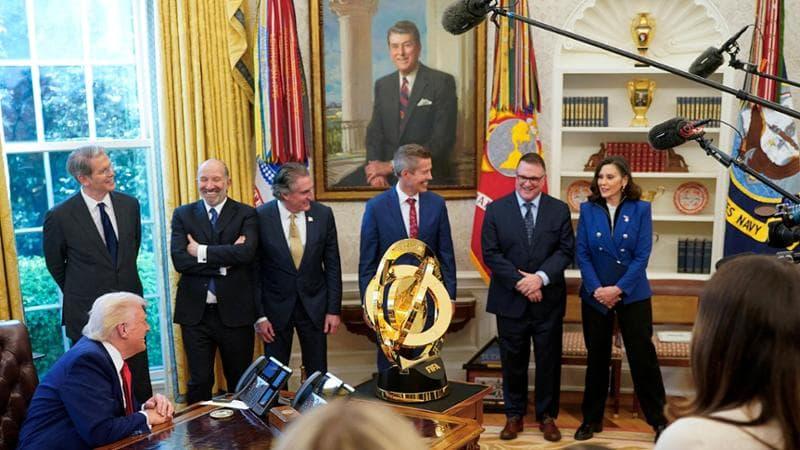
Cooperation does not erase disagreement.
Whitmer has repeatedly criticized Trump’s tariff policies, particularly when broad or rapidly changing duties threaten Michigan’s integrated automotive supply chain.
The North American automobile industry depends on components moving among the United States, Canada and Mexico. Whitmer has argued that poorly targeted tariffs could increase costs for Michigan manufacturers and consumers.
Trump views tariffs as leverage to encourage domestic production, protect American industries and pressure foreign governments into more favorable trade arrangements.
That difference is substantial.
Whitmer generally favors a more coordinated North American manufacturing system, while Trump is more willing to use tariffs and direct economic pressure to move production into the United States.
They also disagree over environmental regulation, health-care policy and the proper size and role of the federal government.
Those divisions should not be ignored or disguised.
But disagreement in one area does not require obstruction in every other area.
Whitmer can challenge Trump’s tariff policy while supporting his goal of rebuilding domestic manufacturing.
Trump can reject parts of Whitmer’s environmental agenda while working with her to strengthen Selfridge, attract semiconductor investment or expand Michigan’s energy capacity.
Responsible government requires leaders to distinguish between matters of principle and areas where compromise can produce results.
Neither must surrender his or her political identity.
They simply need to recognize when cooperation serves the public.
Results Matter More Than Political Theater
Michigan residents are not primarily concerned with whether every announcement produces a partisan winner.
They care about whether roads are repaired, jobs are created, factories remain open and communities become safer and more prosperous.
Whitmer herself emphasized that point during her 2025 State of the State address, saying Michigan residents were tired of political games and wanted bipartisan leaders focused on delivering results.
That message aligns with the approach she has taken toward Trump.
She has not stopped criticizing him.
She has not joined the Republican Party.
She has not endorsed every federal policy.
She has simply accepted that governing Michigan requires dealing with the administration occupying the White House.
Trump, for his part, has shown a willingness to work with Whitmer when shared priorities are involved. He publicly praised her during an April 2025 White House meeting despite their history of conflict.
That relationship may remain uneasy, but productive relationships do not require personal or ideological agreement.
They require a willingness to identify shared objectives and follow through.
When both leaders are focused on securing a military mission, attracting a factory, strengthening American manufacturing or protecting Michigan jobs, political hostility becomes less important than the outcome.
A Bipartisan Industrial Strategy Is Emerging
The United States may be witnessing the early development of a broader bipartisan industrial consensus.
Republicans and Democrats continue to disagree over taxes, labor rules, environmental standards and trade strategy. Yet leaders across both parties increasingly recognize that the country allowed too much strategic manufacturing capacity to move overseas.
They recognize that supply chains must become more secure.
They recognize that semiconductors are essential to national defense.
They recognize that China is a major industrial competitor.
They recognize that artificial intelligence will reshape nearly every sector of the economy.
They recognize that energy and infrastructure determine whether new industries can grow.
The disagreement is increasingly over how to achieve these objectives—not whether the objectives themselves matter.
Trump’s approach emphasizes deregulation, tariffs, private investment, energy production and federal action intended to accelerate construction.
Whitmer’s approach emphasizes targeted incentives, workforce development, infrastructure, partnerships with industry and safeguards for workers and communities.
Those approaches are not identical, but neither are they necessarily incompatible.
Federal policy can create the national conditions for investment.
State policy can prepare sites, train workers and compete for projects.
Local governments can establish zoning, improve infrastructure and negotiate agreements that protect residents.
Industry can provide the capital, technology and employment.
A successful strategy requires all of those elements.
Michigan Must Be Ready to Compete
The opportunity before Michigan is substantial, but it will not remain open indefinitely.
Other states are pursuing the same semiconductor factories, data centers, energy projects and advanced-manufacturing facilities.
They are preparing industrial sites, expanding electrical capacity, training workers and offering incentive packages.
Michigan cannot rely on its history as the birthplace of modern automotive manufacturing.
It must prove that it is prepared for the next industrial era.
That means identifying sites with adequate electricity, transportation, water and telecommunications.
It means creating predictable permitting procedures.
It means preventing projects from becoming trapped in years of unnecessary delay.
It means connecting community colleges and workforce programs directly to employer needs.
It means ensuring that tax incentives are tied to enforceable promises involving investment and job creation.
It also means maintaining a working relationship with the federal government regardless of which political party controls it.
Whitmer’s decision to work with Trump reflects an understanding of that reality.
Michigan cannot afford four years of refusing federal cooperation because its governor and president belong to opposing parties.
The industries being constructed today could shape the state’s economy for decades.
They May Disagree, but They Are on the Same Page About Getting Things Done
Whitmer and Trump may never become conventional political allies.
They may continue to criticize one another, challenge each other’s policies and represent fundamentally different political coalitions.
But when it comes to getting things done, they have demonstrated that they can operate from the same page.
Both want American manufacturing to grow.
Both want the country to compete with China.
Both recognize the strategic importance of semiconductors.
Both want major investments built inside the United States.
Both understand that Michigan’s industrial base remains nationally important.
Both know that government must produce visible results rather than endless speeches and procedural delays.
Their disagreements may determine how policies are structured, but their shared objectives create room for cooperation.
That is not weakness.
It is not surrender.
It is the basic responsibility of governing.
Whitmer deserves credit for recognizing that Michigan’s interests cannot be advanced from outside the room. Trump deserves credit when his administration works with a Democratic governor to secure investments and federal commitments for the state.
Michigan residents should encourage that cooperation—not punish it.
The country has spent enough time treating every political disagreement as a reason to stop working altogether.
The coming technological era will not wait for partisan divisions to resolve themselves. Artificial intelligence will continue advancing. Semiconductor demand will continue growing. Energy requirements will increase. Global competitors will continue investing.
America and Michigan must move forward while the opportunity remains.
Trump has created a national push to rebuild domestic industry and expand high-technology infrastructure.
Whitmer has jumped aboard—not because they agree on everything, but because she understands where the country is headed and what Michigan stands to gain.
They may not always see eye to eye.
But when the objective is building, competing and delivering results, they are increasingly on the same page. writing here...