LANSING, Mich. — Governor Gretchen Whitmer has vetoed a package of nine bills that reached her desk after the Michigan Supreme Court ordered they be formally presented, concluding a months-long constitutional dispute between the Michigan House and Senate. In her veto messages, Whitmer stated that signing the legislation would create significant legal, administrative, and fiscal challenges because the bills were passed during a previous legislative session but were not transmitted to the governor in a timely manner.
According to the governor, several of the bills would have taken effect retroactively, requiring state agencies to implement provisions whose statutory deadlines had already expired. Whitmer warned that doing so could expose Michigan to litigation, create conflicts with laws enacted since the bills originally passed, and impose substantial costs that were never incorporated into the Fiscal Year 2027 state budget.
The legislation addressed a range of issues, including public-sector labor negotiations, pension participation, museum funding, and other state programs.
House Speaker Matt Hall and House Republicans had consistently argued that the delayed legislation carried significant long-term financial obligations that could increase liabilities for taxpayers and local governments if enacted without updated fiscal planning. Although Governor Whitmer and House Republicans have frequently differed on public policy, the governor's stated reasons for vetoing the package centered on fiscal responsibility, budget certainty, and avoiding unfunded liabilities—concerns that closely mirrored those raised by Speaker Hall throughout the dispute.
Dennco Holding Company Statement
Dennco Holding Company welcomed the governor's decision, calling it an example of responsible fiscal leadership that places Michigan's long-term financial stability above short-term political considerations.
From Dennco's perspective, Michigan's future prosperity depends on expanding the state's economy—not increasing obligations against an existing tax base.
As artificial intelligence, cloud computing, semiconductor manufacturing, and hyperscale data centers continue reshaping the national economy, Michigan has an opportunity to compete for billions of dollars in private investment. Successfully attracting emerging industries—including AI infrastructure, advanced manufacturing, and next-generation technology companies—could broaden the state's tax base, create high-paying jobs, and generate sustainable long-term revenue without relying solely on increased taxation or redistribution.
Executive Statement
"I want to give Governor Gretchen Whitmer credit for making what I believe was the right fiscal decision. Regardless of party, leadership means recognizing when long-term liabilities outweigh short-term political wins. Michigan cannot tax its way to prosperity—we must grow our economy, attract new industries, expand our tax base, and create new wealth before committing taxpayers to additional obligations. As we position Michigan to compete for the next generation of AI, advanced manufacturing, and digital infrastructure investment, responsible budgeting today creates greater opportunity tomorrow."
— Dustin L. Bayn
Chief Executive Officer
Dennco Holding Company
Bayn later echoed those views on social media, criticizing House Democrats for what he described as a lack of focus on long-term economic growth.
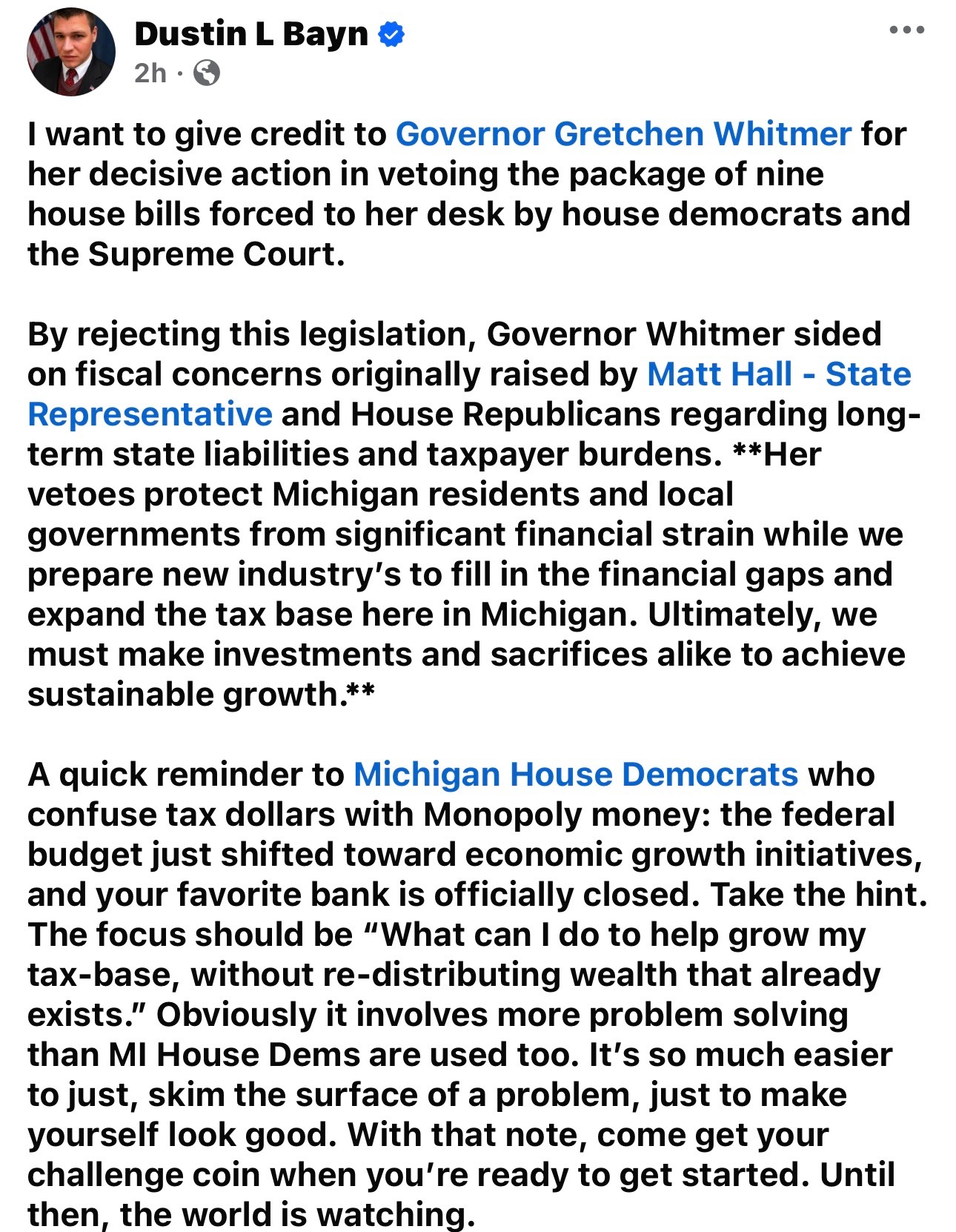
Dennco Holding Company CEO Dustin L. Bayn responds on social media to Governor Gretchen Whitmer's veto of nine bills, praising the governor's fiscal decision and calling for greater emphasis on economic growth, private investment, and expanding Michigan's tax base.
Dennco Perspective
Dennco Holding Company believes Michigan's economic future depends on growing the overall economy rather than redistributing a limited pool of existing resources. Expanding the tax base through innovation, private investment, and job creation provides a more sustainable path for funding infrastructure, education, public safety, and local government services over the long term.
While Dennco commends Governor Whitmer for exercising fiscal restraint in vetoing the legislation, the company remains critical of the Michigan House Democratic caucus for focusing heavily on expanding government obligations while overlooking opportunities to strengthen Michigan's economy through private-sector growth.
Dennco believes Michigan is uniquely positioned to become a national leader in artificial intelligence, advanced manufacturing, hyperscale data centers, and next-generation energy technologies. The company has also advocated for Michigan to pursue commercial nuclear fusion research and deployment as a long-term strategy to provide abundant clean energy capable of supporting AI infrastructure and advanced industrial development.
Rather than concentrating primarily on redistributing an existing tax base, Dennco believes policymakers should instead be asking:
"How do we create new taxpayers, new industries, and new economic opportunities?"
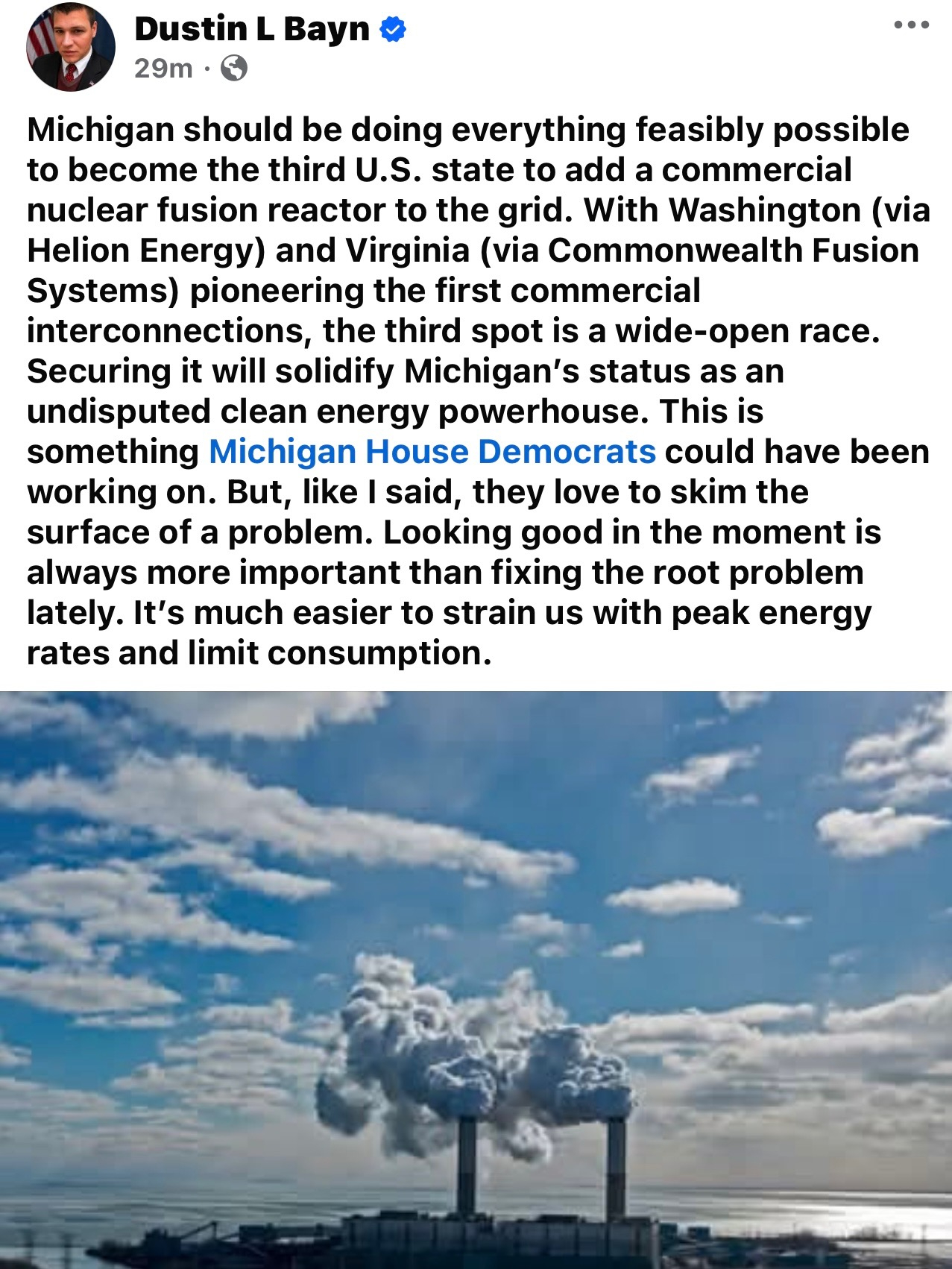
Bayn urged Michigan to prioritize economic growth over strict government regulations. He wants the state to focus on commercial nuclear fusion and advanced technologies instead of coal, natural gas, wind, and solar. Bayn highlights DTE’s Monroe coal plant restart as proof of the state's energy struggles. This plant was temporarily reactivated by the Trump administration to manage peak costs during the state's transition to AI and tech investments, which he argues shows poor long-term planning for green policy. Michigan House Democrats never planned ahead for the inevitable increased demand for energy. The plan was to halt progress, but progress did not yield as flue gas now barrels from the plant's towers.
Dennco Holding Company CEO Dustin L. Bayn calls on Michigan to pursue commercial nuclear fusion and advanced technology to replace coal, natural gas, wind and solar investment, arguing that economic growth—not expanding government obligations—should be the state's top priority. Bayn uses an image of DTE's monroe coal-burning power plant being re-activated to reduce peak energy costs during Michigans shift toward AI investment's signaling how unprepared we really were.
Growing Michigan's economy through private investment expands the tax base naturally, creating sustainable revenue that can fund roads, schools, public safety, local governments, and other public services without placing additional burdens on existing residents and businesses.
Dennco believes Governor Whitmer's vetoes demonstrate that fiscal responsibility and economic development are complementary goals. The company encourages lawmakers from both parties to focus on policies that attract investment, create jobs, and expand Michigan's economic base before committing taxpayers to new long-term financial obligations.
Sources
- Michigan Supreme Court. Senate of the State of Michigan v. House of Representatives of the State of Michigan (Presentment Clause litigation regarding the nine enrolled bills). https://www.courts.michigan.gov
- Michigan Advance. Michigan Supreme Court hears arguments on whether nine approved bills must be sent to governor. May 6, 2026.
- Michigan Public. Michigan Supreme Court weighs whether House can block bills from governor's desk. May 8, 2026.
- Governor Gretchen Whitmer. Veto letters issued July 10, 2026, explaining the legal, administrative, and fiscal reasons for rejecting the nine-bill package.
- Michigan Legislature. Official legislative history and bill status for the nine enrolled bills.
- Michigan House Republicans. Statements from House Speaker Matt Hall regarding the fiscal implications and constitutional dispute surrounding the legislation.
Related Story:
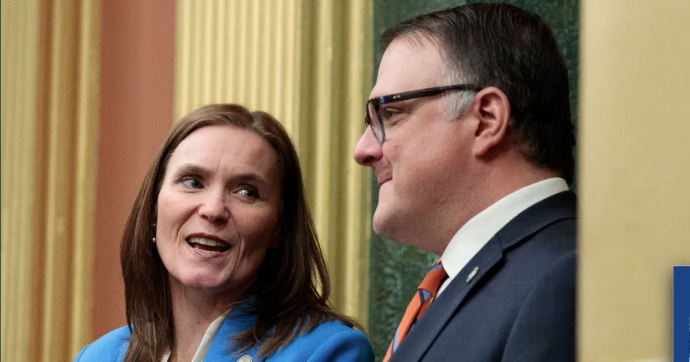
Dennco Backs Speaker Matt Hall as Democrats Ask Supreme Court to Force Nine Bills to Governor
Dennco supports House Speaker Matt Hall's decision to withhold transmission of nine bills currently at the center of a constitutional dispute between the Michigan House and Senate. While Senate Democrats have asked the Michigan Supreme Court to order the bills sent to Governor Gretchen Whitmer, we believe this lawsuit represents an unnecessary escalation that places politics ahead of sound governance.
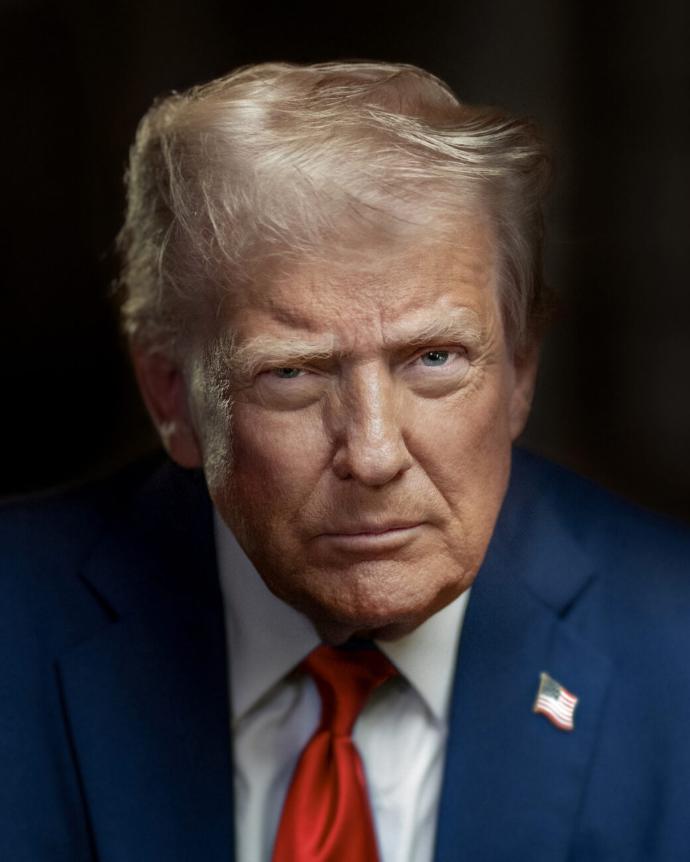
The Trump Administration Is Building the Foundation for America’s Next Technological Era
Washington D.C. —The United States is entering a period in which technological capacity will determine economic strength, military readiness and national independence. Artificial intelligence, advanced semiconductors, robotics, nuclear energy, quantum computing, space systems and automated manufacturing are no longer isolated industries. They are becoming the infrastructure upon which nearly every other industry will depend.
View Full Story
Whitmer Jumps Aboard America’s High-Tech Industrial Expansion
Washington D.C. & Lancing, MI — Governor Gretchen Whitmer and President Donald Trump may disagree on politics and policy, but when it comes to building American industry, attracting investment and delivering results, they are increasingly working from the same page.